From Travel+Style’s Best Travel Quotes
So yesterday I ran across this marvelous quote on
, from philosopher
Martin Buber
:
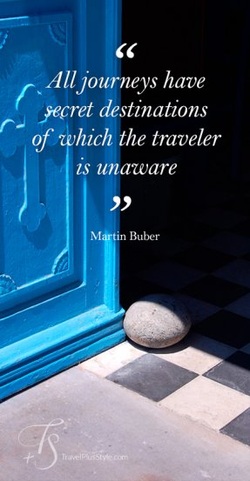
“All journeys have secret destinations of which the traveler is unaware.”
And what is our secret objective? I often think it’s
an unconscious desire to have travel change us in ways we don’t see coming
. Reading Buber’s words, I was suddenly reminded of the fall day nearly three decades ago that Rich and I discovered Washington, California.
We’d been driving through the Sierras for hours, surrounded by nothing but trees, when we came across a signpost for a town deep in a remote valley. On impulse, we turned off the main road and began the steep decent through the pines. Eventually we arrived at a sign that read:
“Washington Pop. 166 Elev. 2846’
.”
A minute later we rolled to a stop in front of the general store and got out.
The store, warmed by a big, pot-bellied stove, held a wall of used paperbacks, rows of gallon jugs of cheap wine, and stacks of food in cans and jars.
“We get snowed in every winter,” the proprietor told us.
“The roads get completely blocked. So we’re stocking up now.”
I stood there a while,
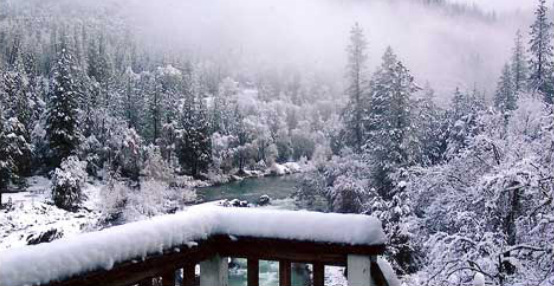
imagining what it would be like to spend each winter cut off from the outside world
. Growing up in California, I’d heard stories about old gold mining towns like this one, but I thought they’d vanished years ago. I saw myself tramping through three feet of snow to reach the general store, sitting around the stove with a cup of coffee, propping my feet up to thaw in the warmth of the crackling wood, sifting through a stack of paperbacks to choose my next one, passing the time of day with a random assortment of the other 165 residents. I pictured going home to a cottage where I’d have all the time I’d ever need to write and think and paint, or simply hibernate until spring rolled around.
Rich and I have never been back to Washington. But we’ve often talked about what it would be like to pass a winter there, snuggled up in a cabin, hanging out at the general store with the town’s mountain men and women, never-let-go hippies, loners, artists, and other offbeat characters.
Just kn
owing that town existed was somehow important to me
, a strange haven for strange times, there if I ever needed that kind of refuge.
This morning, when I told Rich about Buber’s quote and how it made me think of Washington, he said,
“
I wonder what it’s like now.”
I pictured the hideous changes I’d seen in other California small towns: the old dirt road transformed into a highway lined with fast food restaurants and gas stations, a cluster of chain stores around the main square, big box megastores a few miles down the road.
“I don’t think I want to know,” I said.
But it was too late.
Rich and Google had found the town.
I was astonished and tremendously relieved to discover that, so far as I can tell, it hasn’t changed much. The population has grown to 185. They have Internet connection. But in the ways that matter, Washington still seems to be
the land that time forgot
. Here’s Su DeCorte, who owns the town’s hotel, talking about finding gold, and about a biker called “Space” and other “manly men” seeing a ghost on the third floor of her hotel.
Would I really like to live in Washington, CA? Maybe not. But it
is
comforting to know that if I ever should want to leave the modern world and go back to the 1960s, or even the 1860s, it’s still there waiting for me, with a pot-bellied stove, a wall of paperbacks, and enough wine to get through the winter.
Leave a Reply